✅ Pros
- High-quality, pre-treated wood
- Available with and without urine diversion
- Standard seat height
❌ Cons
- Very expensive price
- Not expandable with an exhaust system
- Capture version without odor seal
The Verdict
Premium materials, at a premium price
The Kildwick FancyLoo is a composting toilet offered in two different versions.
The Kildwick FancyLoo is a composting toilet offered in two different versions. On the one hand as a classic composting toilet with two containers, and also as a variant with external urine diversion, which we put through a detailed test for you.
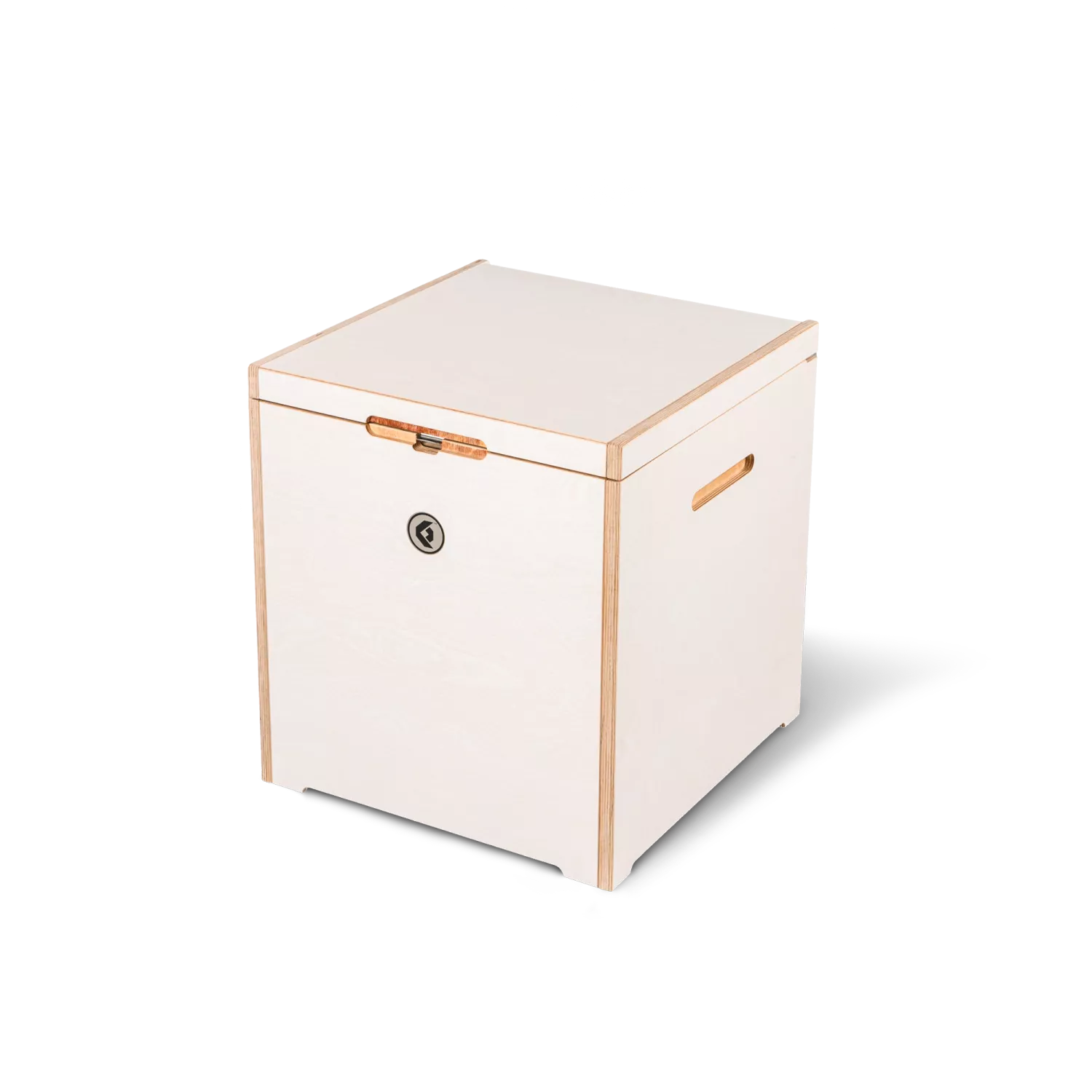
The Kildwick FancyLoo measures 45 cm (17.7 in) (L) x 43 cm (16.9 in) (W) x 48 cm (18.9 in) (H) in the body and weighs around 16.5 kg (36.4 lb), which, like the EasyLoo, makes it more suited for stationary operation, for example in a garden house, tiny house, or permanently installed camper, and less for frequent mobile use.
The composting toilet is available in the Capture variant (839.90 €) with a urine canister, and as the Divert variant (949.90 €) with external urine diversion, making it the most expensive in Kildwick's entire lineup. The tested load capacity, according to the manufacturer, is 150 kg (330.7 lb). We deliberately chose the Divert version, as it's the only model offering external urine diversion via an integrated stainless-steel siphon with a connected hose.
Assembly
Assembly is limited to setting up the fully pre-assembled housing, inserting and lining the 16-liter (4.2 gal) solids container with a matching inlay, and connecting the urine hose to an external container. To comfortably use the fairly short factory hose, we chose a 20-liter (5.3 gal) tank canister as an example and extended the line with an additional piece of hose, which we secured firmly with a clamp.
Material and workmanship
For all wooden parts of the FancyLoo Divert, housing and seat ring, Kildwick uses 15 mm (0.6 in) thick plywood from the Finnish company Koskisen, sustainably sealed with a semi-transparent KoskiDecor finish. Compared to the thinner 8 or 9 mm (0.3 to 0.4 in) panels of other Kildwick models, the sturdy material conveys noticeably more stability and a better feel. The urine diverter is made of ABS plastic, and all metal components, including the siphon, are made of V2A stainless steel. The precise CNC manufacturing and the careful beeswax sealing on all edges protect against moisture and splash water.
Comfort
Although the seat height isn't explicitly stated, the overall body height of 48 cm (18.9 in) roughly corresponds to the standard of a ceramic toilet, resulting in a comparably comfortable seating position. The only drawback is the lack of a separate toilet lid: the wooden seat ring merely rests in place, and the outer housing serves as the cover, which can't be closed airtight. Aside from that, though, the FancyLoo is among the more comfortable composting toilets in Kildwick's range.
Odor development
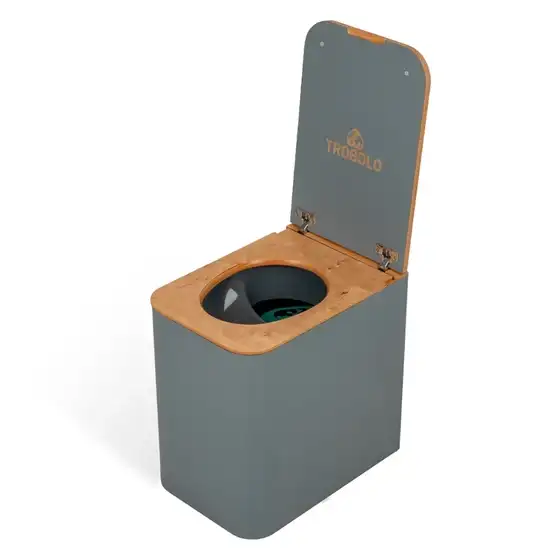
Thanks to the integrated siphon and external urine diversion, unpleasant odors inside are practically eliminated entirely. Unlike pure capture models or systems without an odor seal, this results in no urine smell. However, there's no factory option to retrofit an exhaust system, a feature one might well expect from a premium product in this price range. The TROBOLO TinyBlœm, for example, offers external urine diversion together with an integrated ventilation system at a noticeably lower price.
Value for money
At a price of nearly 950 €, the FancyLoo Divert is above that of many other composting toilets. The high-quality choice of materials, precise workmanship, and effective odor control justify a premium, but for us, sensible extras such as an airtight-closing lid or prepared exhaust integration are missing. Taking these points into account, the balance of equipment, comfort, and especially price therefore comes out only below average.
Our conclusion
The Kildwick FancyLoo Divert is a very solidly built, odor-free composting toilet that particularly impresses as a stationary solution in the upper price segment. Anyone who values high-quality materials and external urine diversion, and is willing to spend nearly 1,000 €, will find a well-thought-out system that nonetheless has some weaknesses. A bit of a shame, really, because the concept is fundamentally solid, but the execution ultimately doesn't fully convince us.