
Our Test Winners
Looking for the best composting toilet? Find independent information, honest reviews, and test winners for home, garden, and camping.
Start with our guides on how they work, what maintenance looks like, and how to pick the right size and type for your space.
Trusted brands




Why a composting toilet
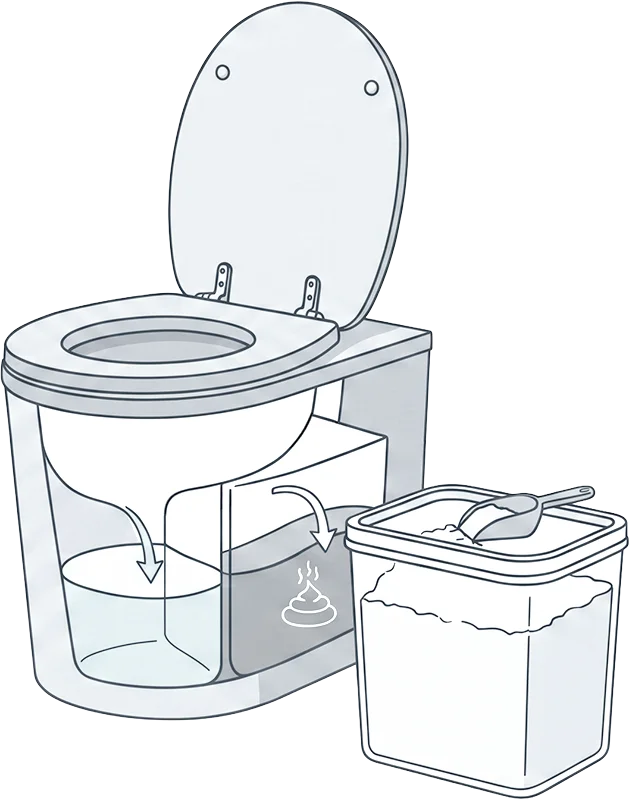
Composting toilets are becoming increasingly popular over time. But how do these models differ from a "normal" toilet? The biggest difference is that solid and liquid waste in a composting toilet does not fall into the same bowl. Instead, they are separated during use. This happens via an integrated urine diverter that separates urine and feces from one another and directs them into different containers.
This separation is responsible for one of the main advantages of a composting toilet: the absence of odor. By separating solid and liquid matter, toilet odors are significantly reduced and largely prevented. This is because toilet odors mostly arise when solids decompose in the presence of moisture such as urine. By binding the resulting moisture with ecological bedding material, the decomposition process is slowed down, directly suppressing unpleasant odors at their source.
Another advantage of a composting toilet is that, unlike a conventional toilet, it works without water. With conventional toilets, all waste is flushed into the drain, where it is treated at a sewage treatment plant. With a composting toilet, however, the waste is collected in containers, which means it can, for example, be composted and used as fertilizer. This makes a composting toilet doubly environmentally friendly: through composting, and through the water saved.
You might be worried about having to forgo the comfort of a conventional toilet if you get a composting toilet. Fortunately, this concern is largely unfounded. The seating position of a composting toilet is identical to that of a traditional toilet, which applies equally to men and women. The only real adjustment is that urinating while standing should be avoided, since otherwise the urine won't be separated correctly.
Beyond that, the height and diameter of the toilet body and seat on many composting toilets correspond to standard toilet dimensions, though some products turn out somewhat lower due to their compactness.
Experience shows that users are pleasantly surprised by the comfort of a composting toilet. The lack of odor in particular impresses many people, making the composting toilet a great option for indoor use, garden use, and camping.
One of the best-known manufacturers of composting toilets is TROBOLO. The brand stands for quality, sustainability, and thoughtful design. We were particularly impressed by the WandaGO, a mobile solution with high functionality, as well as the aesthetic TeraBlœm, which blends beautifully into living spaces. For its wooden products, TROBOLO consistently relies on FSC-certified wood from sustainable forestry, complemented by robust polypropylene variants such as the WandaGO and BilaBox for mobile use.
The Kildwick toilets also enjoy considerable popularity. These models separate liquids from solids and enable hygienic, water-free disposal. We were particularly impressed by the MiniLoo HYDRO, compact, modern, and ideal for smaller spaces or mobile use.
Anyone looking for an attractively priced solution will find what they need at Trelino. The toilets, made of durable plastic, are user-friendly and ideal for families. We were particularly impressed by the Timber L model, which combines functionality, pleasant design, and generous capacity.
BOXIO rounds things out with compact, Eurobox-format toilets built for portability, reviewed here as the BOXIO Toilet.
Common questions
A composting toilet is a toilet in which human waste and toilet paper are converted into humus through biological processes.
A composting toilet doesn't use flushing water. Instead, the waste is separated during use, and the solid material is covered with bedding made of sawdust, peat, or similar materials to reduce odors and absorb moisture.
How often a composting toilet needs to be emptied depends on the size of the tank or container and the number of users. As a rule, it needs emptying somewhere between every few weeks and every couple of months.
Yes, toilet paper can be used in a composting toilet without any problems. Ideally, however, you should use toilet paper that is biodegradable.
A properly operated composting toilet should not smell. Some models offer optional ventilation systems to reduce odors even further. If odors do develop, bedding material can be used, which binds moisture and thus counteracts unpleasant smells.
Yes, a composting toilet can be used outdoors. There are special models designed for outdoor use.
Prices vary a lot depending on the model, size and features. A simple composting toilet can start at a little over €100, while more elaborate models cost considerably more. In practice, most of the toilets we've reviewed fall somewhere between about €130 and €1,500.
Yes, a composting toilet can be used in the home. Odor development can be counteracted with bedding material specifically designed for composting toilets, and there are various models and sizes of composting toilets that can be adapted to the needs of a household. However, it's important to note that handling solid waste and urine is somewhat different when using a composting toilet compared to a conventional toilet, so it's worth thoroughly informing yourself about the use and maintenance of a composting toilet before deciding on one.